


Justice and the Bible
A deep dive into Walter Benjamin’s “Critique of Violence”
Questions of justice and the law are central to modern German-Jewish thought, resonating across a diverse spectrum of its intellectual canon comprising, among other fields, philosophy, literature, and political theory. This rich corpus includes voices from Arendt to Adorno, from Bloch to Buber, from Kafka to Kelsen, from Scholem to Susman, and many more.
Among the writings by this diverse array of thinkers, Walter Benjamin’s early essay, “Zur Kritik der Gewalt” (Toward the Critique of Violence), published in 1921, stands out for its conceptual and hermeneutic complexity, its vast and polarized reception, and, most notably, for the specificity of its engagement with the Jewish tradition and the Bible in particular. Benjamin's essay adds a Jewish dimension to the urgent concerns shared by many intellectuals of the time: a profound dissatisfaction with the prevailing conditions linked to the political and legal order, coupled with probing questions about the legitimacy of revolutionary violence. Benjamin’s most essential and controversial contribution to this conundrum is the enigmatic concept of “divine violence,” which he invokes as a model for legitimate revolutionary action. Benjamin’s essay has spurred a wide range of often radically divergent interpretations and judgments by leading philosophers and scholars. In this talk, Vivian Liska will explore how Benjamin’s engagement with the Jewish scriptural tradition illuminates his notion of “divine violence” and his essay as a whole. Ultimately, this exploration aims to reveal the specificity of Benjamin’s idea of justice and the idiosyncratic role and function of references to the Bible he introduces into modern German-Jewish thought.
Deze cursus wordt gegeven in het Engels.


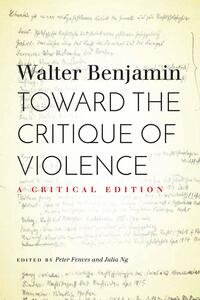
Walter Benjamin
Stanford University Press, 2021
ISBN: 0804749531
Ook als e-book verkrijgbaar
Oorsponkelijke titel: Zur Kritik der Gewalt
Walter Bendix Schönflies Benjamin (15 July 1892 – 26 September 1940) was a German-Jewish philosopher, cultural critic, media theorist, and essayist. An eclectic thinker who combined elements of German idealism, Jewish mysticism, Western Marxism, and post-Kantianism, he made contributions to the philosophy of history, metaphysics, historical materialism, criticism, aesthetics and had an oblique but overwhelmingly influential impact on the resurrection of the Kabbalah by virtue of his life-long epistolary relationship with Gershom Scholem.
Source: Wikipedia

Popup